A Cockle Cylinder (Indented Cylinder Separator) is an industrial grain-cleaning machine used to separate cockle seeds, broken grains and other impurities from wheat and other cereals according to their length.
The machine uses a rotating cylindrical screen with specially shaped indentations. These indentations lift shorter or longer particles (depending on cylinder design) and separate them from the main grain flow.
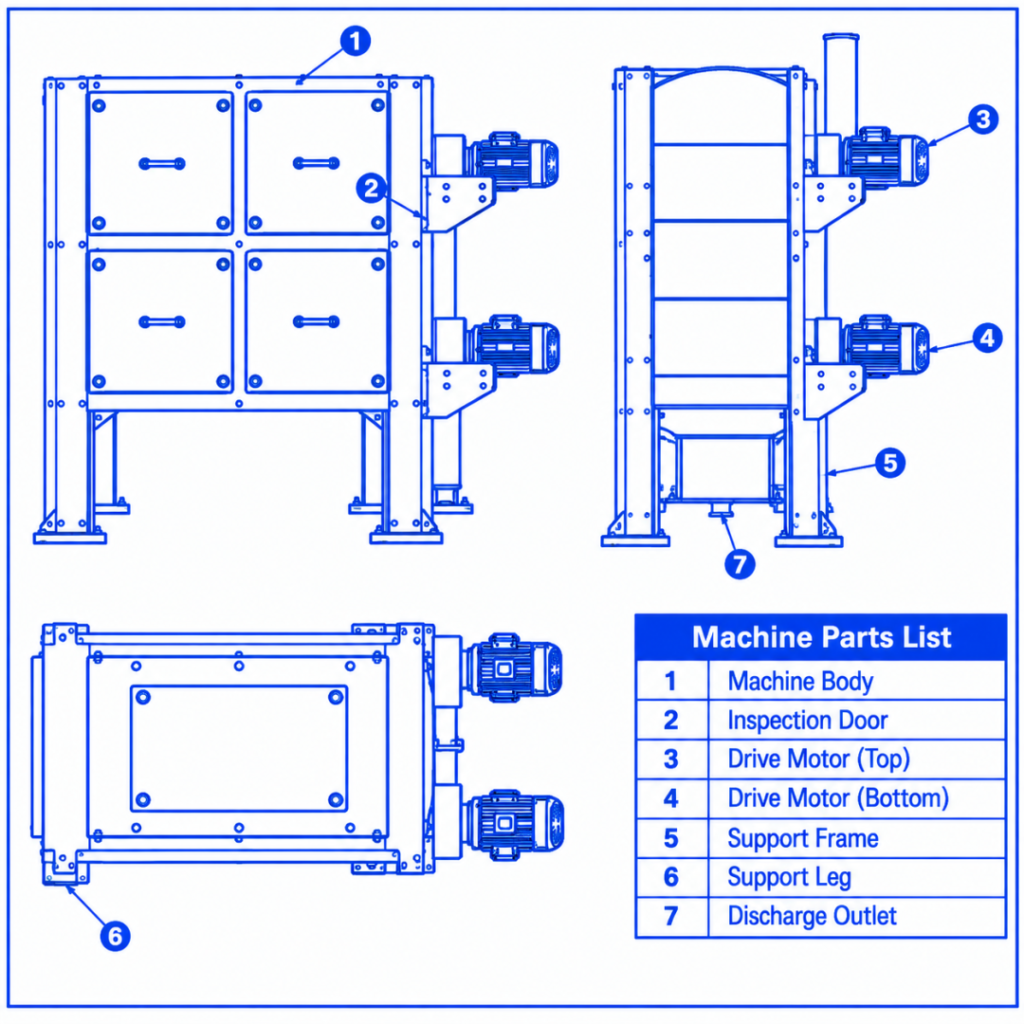
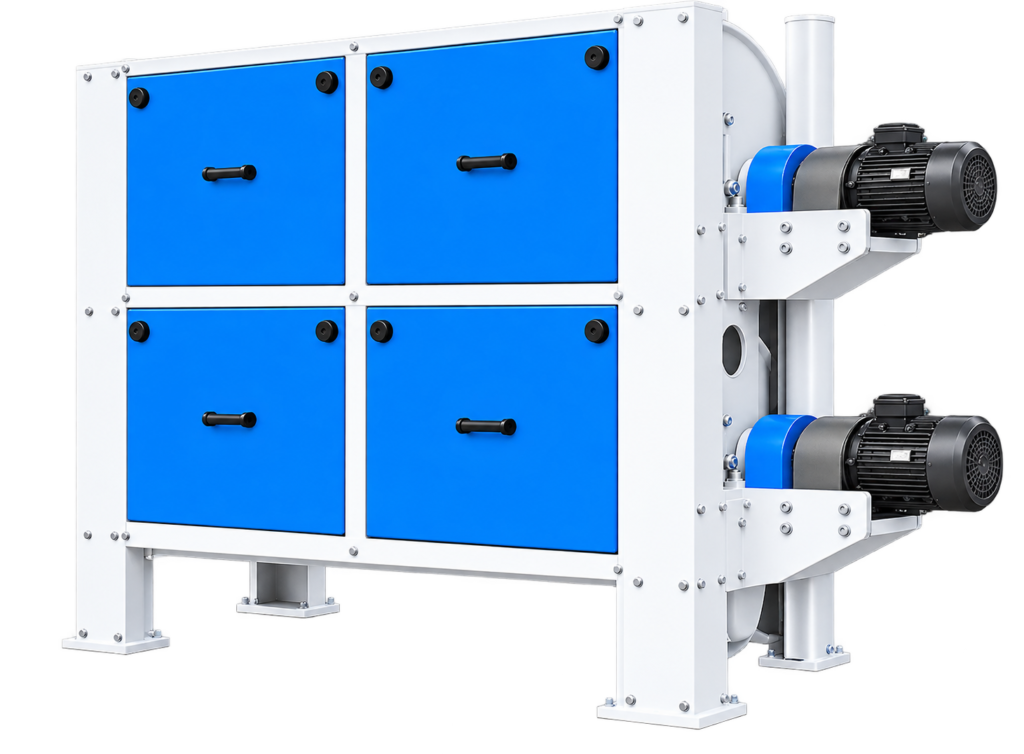
The machine shown has a heavy-duty enclosed housing, inspection doors, rotating cylinder assembly and two external drive motors.
Durable – Heavy-duty construction for long service life.
Reliable – Consistent operation for industrial applications.
Easy Maintenance – Convenient access for inspection and servicing.
02 / Applications
Main uses
01
Removing cockle seeds from wheat.
02
Separating broken and undersized grains.
03
Removing short or long impurities from cereals.
04
Improving grain purity before milling.
05
Cleaning seed lots before further processing.
06
Separating grains according to length differences.
03 / Material compatibility
Suitable materials
Materials validated for the machine. Compatibility can depend on moisture, particle size, abrasiveness, temperature and product characteristics.
Wheat
Rice and paddy
Barley
Oats
Maize
Broken rice
Lentils and pulses
Coffee beans
Sunflower seeds
Mustard seeds
Grass seeds
Vegetable seeds
04 / Process
Working principle
The cylinder indentation size and trough position determine the separation accuracy. Different cylinder configurations can separate either short or long particles.
Grain Feeding
Grain enters the machine through the feeding inlet.
Rotating Cylinder Processing
The product moves inside a rotating indented cylinder.
Short Grain Separation
Short grains or impurities fit into the cylinder pockets.
Particle Lifting
The rotating cylinder lifts these particles upward.
Particle Collection
The particles fall into an adjustable internal collection trough.
Material Discharge
A screw conveyor transports the separated material to its discharge outlet.
Grain Discharge
The remaining grain travels to a separate outlet.
05 / Technical data
Technical specifications
Final specifications depend on the selected model and process requirements. Confirm all values with the machine datasheet.
Model
COCKLE CYLINDER
Capacity
Approx. 500–1,000 kg/hour
Motor power
Approx. 2 × 3 HP
Operating speed
Approx. 1,440 RPM
Machine dimensions (L × W × H)
Approx. 1,800 × 1,200 × 1,800 mm
Machine weight
Approx. 700–1,000 kg
Material of construction
Mild Steel (MS)
Electrical supply
415 V, 3 Phase, 50 Hz
Control system
Electrical Control Panel
Inlet / outlet connection
Customized as per plant layout
06 / Plant planning
Installation recommendations
Recommended planning area: 16 m². Plan the installation using the approved general arrangement drawing, foundation details and utility schedule supplied for the selected model.
⌂
Floor area / footprint
Provide adequate floor space for installation, operation, and material handling.
▦
Foundation and support
Install on level concrete flooring with stable vibration-resistant structural support.
⚡
Electrical and utilities
Ensure proper electrical supply, grounding, and connections for reliable operation.
↔
Access and maintenance
Maintain sufficient clearance for inspection, cleaning, servicing, and component replacement.