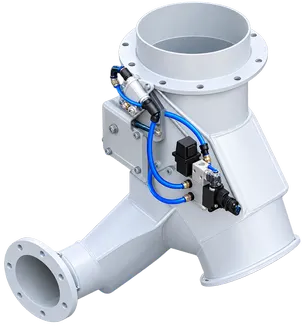
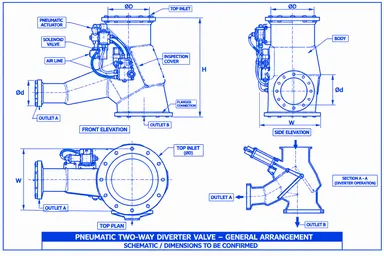
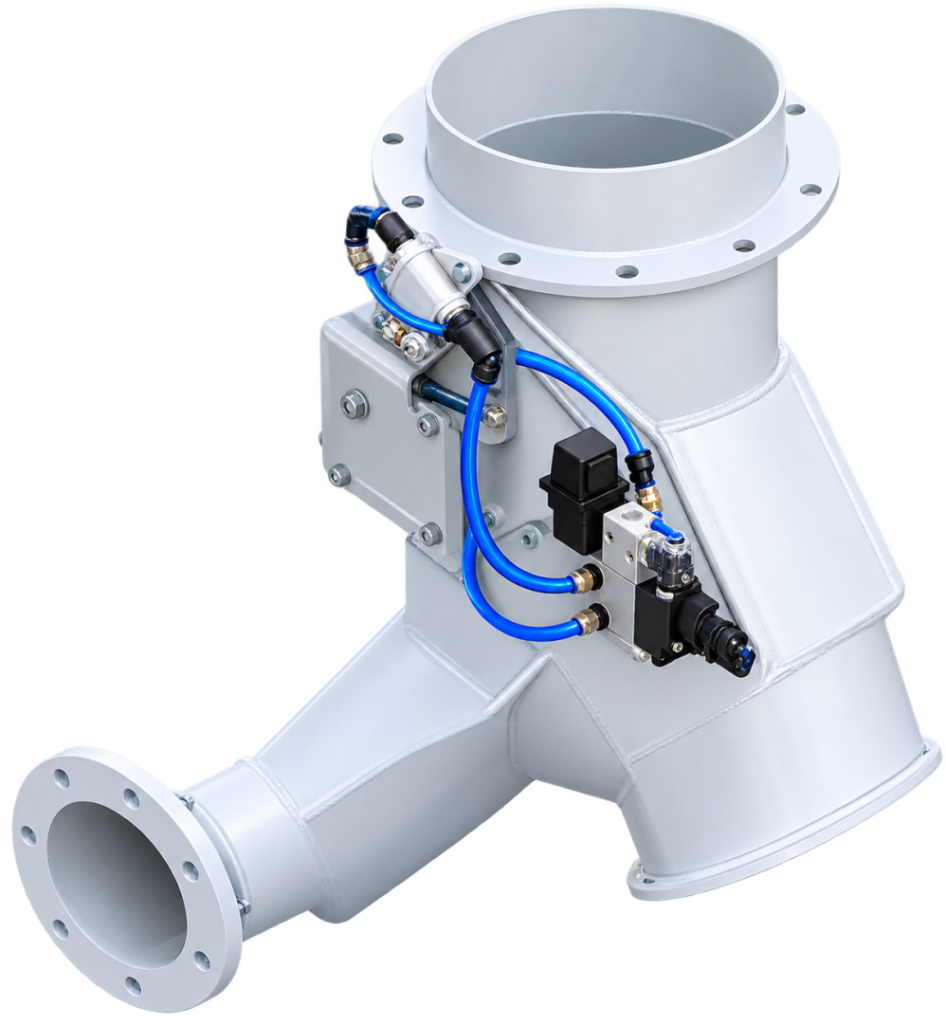
The pneumatic two-way diverter valve efficiently redirects bulk materials between two discharge outlets. Its pneumatic flap mechanism provides controlled material distribution, reliable switching, and smooth conveying operations. Designed for industrial applications, it supports automated routing, consistent flow management, and dependable processing performance.
This pneumatic diverter valve redirects bulk materials between two discharge outlets through an actuated flap. Its durable construction supports automated conveying, controlled distribution, reliable switching, and efficient processing.
Why choose this machine
Reliable, precise material flow control.
Accurate Diversion – Directs materials between outlets.
Robust Construction – Supports demanding industrial applications.
Easy Maintenance – Simplifies inspection and servicing.
02 / Applications
Main uses
01
Diverting bulk materials between two conveying lines.
02
Directing grains toward separate processing equipment efficiently.
03
Distributing products between different storage silos automatically.
04
Switching material discharge between alternative production routes.
05
Controlling powder flow through industrial conveying systems.
06
Automating material distribution across multiple processing destinations.
03 / Material compatibility
Suitable materials
Materials validated for the machine. Compatibility can depend on moisture, particle size, abrasiveness, temperature and product characteristics.
Wheat
Rice and paddy
Barley
Corn
Maize
Millet
Sorghum
Coffee beans
Barley
Pulses
Oats
Lentils and Pulses
04 / Process
Working principle
The valve uses a pneumatic actuator to move an internal flap between two positions. This movement selects the required discharge passage, directing incoming material toward the chosen outlet.
Material Entry
Bulk material enters through inlet opening.
Initial Positioning
Flap aligns with the selected outlet.
Pneumatic Activation
Compressed air activates the pneumatic actuator.
Flap Movement
Actuator moves flap toward alternate position.
Flow Direction
Material travels through selected discharge passage.
Outlet Discharge
Material exits into connected conveying equipment.
Position Reset
Control signal returns flap when required.
05 / Technical data
Technical specifications
Final specifications depend on valve size, material characteristics, operating pressure, and customer requirements.
Model
Pneumatic Two-Way Diverter Valve
Capacity
Application-dependent
Motor power
None
Operating speed
Actuator-dependent
Machine dimensions (L × W × H)
As per machine's design
Machine weight
Model-dependent
Material of construction
Mild Steel (MS) / SS304
Electrical supply
As per machine's design
Control system
As per machine's design
Inlet / outlet connection
Customized as per plant layout
06 / Plant planning
Installation recommendations
Install the valve securely within the conveying pipeline, ensuring proper alignment, adequate pneumatic supply, accessible connections, and sufficient maintenance clearance.
⌂
Floor area / footprint
Allocate sufficient space around the valve for installation and inspection activities.
▦
Foundation and support
Provide stable mounting supports to prevent vibration, movement, and structural stress.
⚡
Electrical and utilities
Ensure reliable compressed air supply and suitable electrical control connections availability.
↔
Access and maintenance
Maintain clear access for actuator inspection, flap servicing, and routine cleaning.
A pneumatic two-way diverter uses compressed air to operate its flap, while flap type describes the internal mechanism that directs material between outlets.