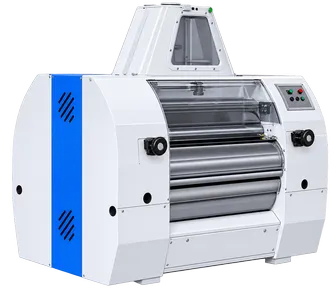
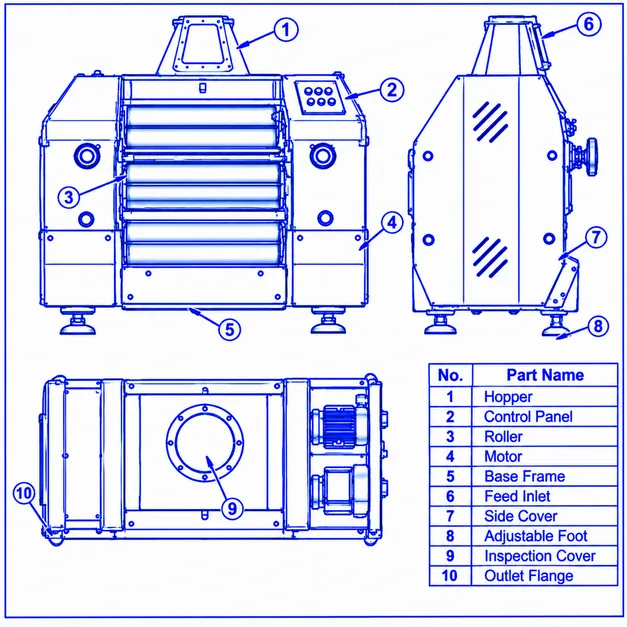
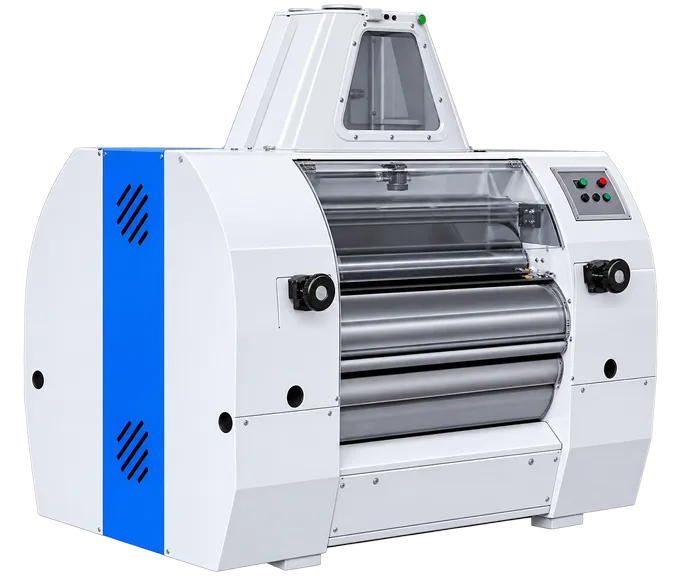
The Roller Mill Machine is designed for efficient grinding and size reduction of grains in industrial milling operations. It uses precision-engineered rotating rollers to crush and shear grain kernels into controlled particle sizes. Its adjustable roller settings support consistent grinding performance, improved flour quality, and reliable production. Suitable for wheat mills, grain processing plants, and commercial flour manufacturing facilities.
The Roller Mill Machine uses adjustable rotating rollers to grind grains into controlled particle sizes. Its robust construction supports consistent milling, efficient production, and reliable industrial operation.
Why choose this machine
Achieve consistent grain grinding.
Precise Particle Control – Produces uniform grinding results
Adjustable Roller Settings – Controls grinding gap precisely
Durable Machine Construction – Ensures dependable industrial operation
02 / Applications
Main uses
01
Grinding wheat kernels for commercial flour production.
02
Reducing grain particles during industrial milling operations.
03
Producing consistent flour through controlled roller grinding.
04
Processing cereals for food manufacturing applications.
05
Preparing grain stocks for subsequent milling stages.
06
Adjusting particle sizes for different flour grades.
03 / Material compatibility
Suitable materials
Materials validated for the machine. Compatibility can depend on moisture, particle size, abrasiveness, temperature and product characteristics.
Wheat
Rice
Paddy
Corn
Maize
Millet
Sorghum
Coffee beans
Barley
Pulses
Oats
Grain Mixtures
04 / Process
Working principle
The Roller Mill Machine works by feeding grain between rotating rollers. The rollers apply controlled compression and shearing forces to reduce particle size. Adjustable roller gaps help achieve the required grinding fineness for different milling applications.
Material Feeding
Grain enters through the machine’s feeding system.
Flow Distribution
Feed rollers distribute material across grinding rollers.
Roller Rotation
Driven rollers rotate at controlled operating speeds.
Material Compression
Grain passes through the adjustable roller gap.
Particle Reduction
Compression and shearing forces reduce grain size.
Ground Material Collection
Processed particles move towards the discharge outlet.
Further Classification
Ground material proceeds to subsequent sifting stages.
05 / Technical data
Technical specifications
Actual capacity, motor power, roller speed, dimensions, and weight depend on the selected model and milling requirements. Confirm specifications using the our technical datasheet.
Model
Roller Mill
Capacity
Model-dependent
Motor power
Model-dependent
Operating speed
Model-dependent
Machine dimensions (L × W × H)
As per machine's design
Machine weight
Model-dependent
Material of construction
Mild Steel (MS) / SS304
Electrical supply
As per machine's design
Control system
As per machine's design
Inlet / outlet connection
Customized as per plant layout
06 / Plant planning
Installation recommendations
Install the Roller Mill on a stable foundation, ensuring proper alignment, secure connections, adequate ventilation, and sufficient maintenance clearance.
⌂
Floor area / footprint
Provide sufficient floor space for installation, operation, inspection, and material handling.
▦
Foundation and support
Install on level flooring with secure anchoring and vibration-resistant structural support.
⚡
Electrical and utilities
Provide compatible electrical supply, proper earthing, and accessible motor protection equipment.
↔
Access and maintenance
Maintain sufficient clearance for roller adjustment, cleaning, inspection, and component replacement.
Regularly inspect roller surfaces, bearings, drive components, and adjustment mechanisms. Keep the machine clean and follow the manufacturer’s lubrication and servicing schedule.
Discuss your application
Looking for the right machine configuration?
Send your process details and our team can help identify a suitable configuration.