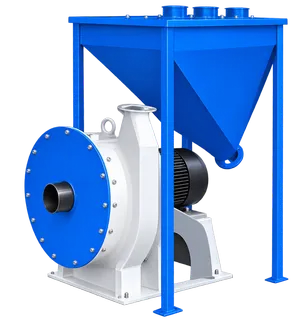
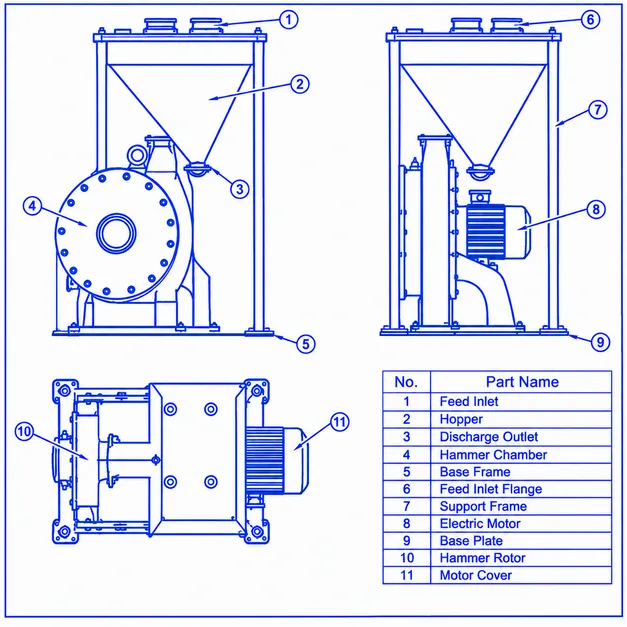
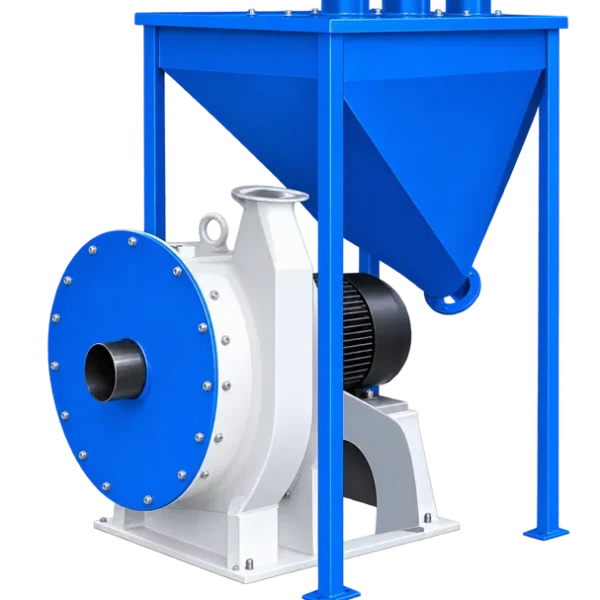
The hammer mill machine efficiently reduces the size of grains and other raw materials through high-speed rotating hammers. Its grinding chamber breaks materials into smaller particles, producing a uniform output for further processing. Designed for industrial applications, it supports continuous operation, adjustable particle sizing, and reliable grinding performance across agricultural, food processing, feed manufacturing, and other material processing industries.
The hammer mill reduces material size through high-speed impact grinding. Its rotating hammers and grinding chamber deliver consistent particle reduction, supporting efficient processing across agricultural and industrial applications.
Why choose this machine
Achieve efficient material grinding.
Powerful Grinding – Breaks materials into smaller particles.
Robust Construction – Ensures dependable industrial operation.
Easy Maintenance – Simplifies inspection and servicing.
02 / Applications
Main uses
01
Grinding agricultural grains before further processing operations.
02
Producing finely ground materials for animal feed manufacturing.
03
Reducing particle sizes of various agricultural products.
04
Processing cereals for flour and feed production.
05
Grinding raw materials for industrial processing applications.
06
Preparing biomass materials for further size reduction processes.
03 / Material compatibility
Suitable materials
Materials validated for the machine. Compatibility can depend on moisture, particle size, abrasiveness, temperature and product characteristics.
Wheat
Rice and paddy
Barley
Corn
Maize
Millet
Sorghum
Coffee beans
Barley
Pulses
Bran and Biomass
Lentils and Pulses
04 / Process
Working principle
The hammer mill operates through high-speed impact. Material enters the grinding chamber, where rotating hammers strike and break it into smaller particles. The ground material passes through a screen once it reaches the required particle size.
Material Feeding
Raw material enters through the feeding hopper.
Chamber Entry
Material moves into the enclosed grinding chamber.
Rotor Rotation
Motor drives the rotor at high speed.
Hammer Impact
Rotating hammers strike and break incoming materials.
Particle Reduction
Repeated impacts reduce material into smaller particles.
Screening Process
Ground particles pass through appropriately sized screen openings.
Product Discharge
Finished material exits through the discharge outlet.
05 / Technical data
Technical specifications
Actual specifications depend on machine model, rotor configuration, screen size, material characteristics, and required output capacity.
Model
Hammer Mill
Capacity
Model-dependent
Motor power
Model-dependent
Operating speed
Model-dependent
Machine dimensions (L × W × H)
As per machine's design
Machine weight
Model-dependent
Material of construction
Mild Steel (MS) / SS304
Electrical supply
As per machine's design
Control system
As per machine's design
Inlet / outlet connection
Customized as per plant layout
06 / Plant planning
Installation recommendations
Install the hammer mill on a stable foundation, ensuring proper alignment, electrical connections, ventilation, material feeding, and sufficient maintenance clearance.
⌂
Floor area / footprint
Provide sufficient space for machine installation, feeding, discharge, and operator movement.
▦
Foundation and support
Use a level foundation supporting machine weight, vibration, and operational loads.
⚡
Electrical and utilities
Provide suitable electrical connections and reliable power for motor operation.
↔
Access and maintenance
Maintain clear access for screen replacement, hammer inspection, cleaning, and servicing.